
Why Your Systems Don’t Talk to Each Other
And how to connect them without making a mess
A new customer signs a contract. Someone enters their details into the CRM. Then someone in finance types the same details into the finance system. Then someone in HR or operations does it again.
Nobody calls this a problem. It’s just “how we do things here”.
That was where we started at our October Lunch & Learn on integrations, and almost everyone in the room recognised their own organisation in it. Here’s what we covered, and what I’d suggest if your systems feel more like islands than a network.
What is an integration?
Strip away the jargon and it’s simple. An integration moves data from one system (the source) to another (the target) when something tells it to. That something is a trigger: an event, like a contract being signed or a purchase order being approved, or a schedule, like every 15 minutes or once a day.
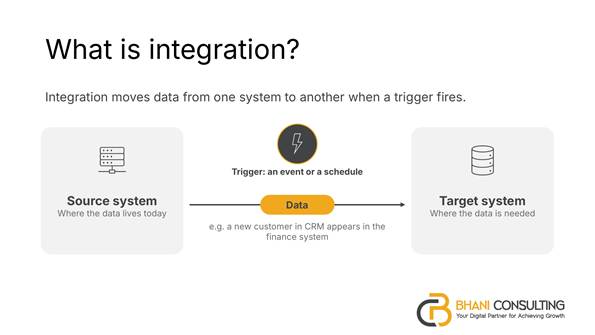
When that new customer appears in your finance system without anyone retyping it, that’s an integration doing its job.
Why it matters?
- The demand is real. Businesses, councils and not-for-profits all want their systems to share data. Nobody wants to pay skilled people to copy and paste.
- It’s harder than it looks. Connecting two systems sounds like a small technical job. In practice, it touches processes, people and ownership.
- It gets messy over time. Without a bigger picture, one integration gets added here and another there. A few years later, nobody is sure what talks to what, or what breaks when one system changes.
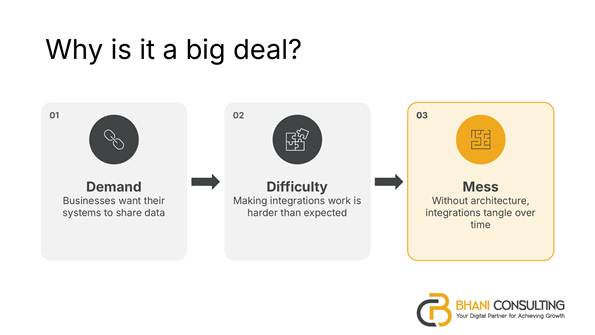
Demand leads to difficulty, and without architecture, difficulty leads to mess.
Why integrations are so hard?
In my experience, three things get in the way.
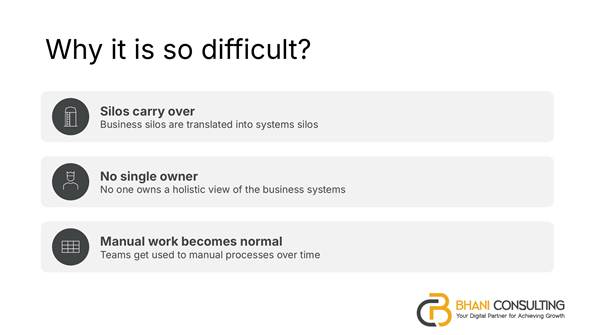
The three reasons integrations stall.
Silos carry over. If finance, operations, sales and procurement don’t work closely together, their systems won’t either. One attendee who works with councils pointed out that a single council can run up to 40 different supply chains. That’s a lot of information trying to flow between teams that don’t always talk.
Nobody owns the whole picture. Each department looks after its own system, but no one is accountable for how they all connect. So integrations get built in isolation, and the tangle grows.
Manual work becomes normal. This is the sneaky one. When people have keyed the same data into three systems for years, they stop seeing it as a problem. The workaround becomes invisible.
Another attendee shared a good example: a WA business that had grown about 80% in a year. Time was captured on the shop floor, separately from payroll, so nobody could see the real labour cost of each job. Someone keyed the data in manually at month end, and the rest was guesswork. What they wanted, like so many organisations, was a single source of truth.
Step back before you connect anything
The biggest message of the session: look at the whole landscape before you build the first link. Start with four questions about your business systems:
- How many systems need to connect?
- What data needs to move, and between which systems?
- How much does that data need to change or sync along the way?
- What are the security and privacy requirements as data leaves one system for another?
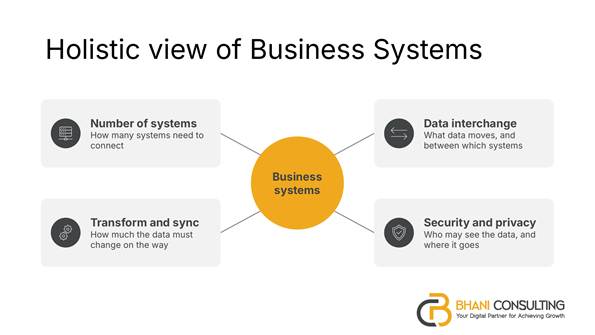
Start with a holistic view of your business systems.
Then, for each integration, get clear on the details:
- Purpose: why does the other system need this data at all?
- Master: which system owns the data and is the source of truth?
- Direction: one-way or two-way?
- Frequency: how often does the data need to sync?
- Timing: does it need to happen instantly, or can it wait?
- Trigger: what starts it? A button, an approved purchase order, a sent invoice?
- Exceptions: when something fails, how will you know, and how will you fix it?
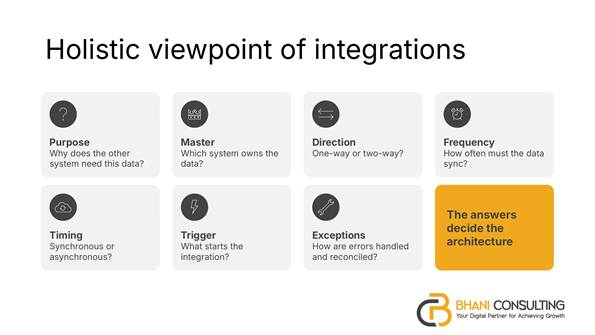
Seven questions to answer for every integration.
The answers decide the architecture, not the other way around.
Choosing the right architecture
There’s no single right answer. The common options are:
- Point-to-point: systems connect directly. Quick and practical for a few systems, and what most medium-sized organisations use. It becomes a tangle as you add more.
- Hub-and-spoke: a central hub routes data, so each system connects only once.
- Enterprise service bus (ESB): a central bus handles routing, transformation and business rules. More common in larger organisations with many on-premise applications.
- Cloud middleware (iPaaS): platforms such as Boomi, MuleSoft, Azure or Workato. Often a good fit for cloud and hybrid environments.
- Event-driven: systems publish events like “invoice approved” and other systems react.
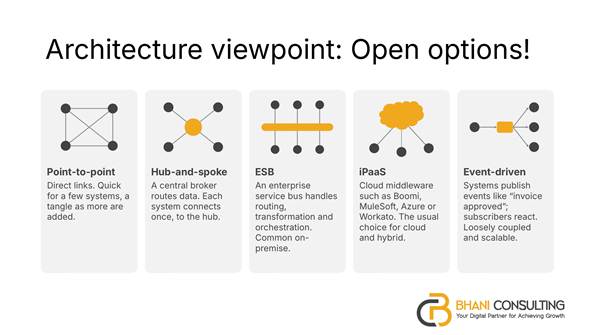
Common integration architectures. There is no single right answer.
Trouble starts when an organisation begins with point-to-point for four systems, grows to ten or twenty, and never changes approach. For most medium-sized organisations, point-to-point works well for simple needs, and middleware works well as things grow.
Four things that shape your strategy
- Business needs: what do you actually need the integrations to do?
- Capability: do you have the people and skills to build, support and maintain them, or will you need a partner?
- Constraints: what are your limits on budget, technology and timeline?
- IT strategy: does this fit where your organisation is heading over the next five to ten years?
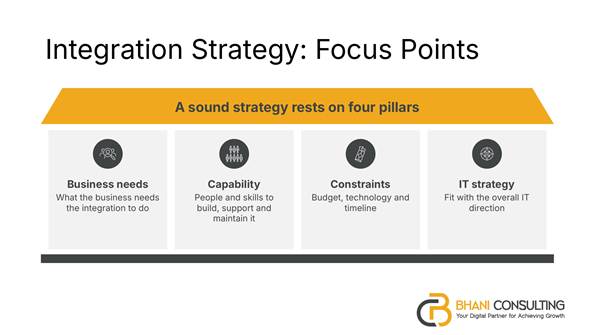
A sound integration strategy rests on four pillars.
You can still start small
Thinking big doesn’t mean building big. You can take it one step at a time:
- Step 1, manual CSV: someone exports a file from one system and imports it into another.
- Step 2, automated CSV: a scheduled job does the import for you.
- Step 3, API integration: the systems exchange data directly, closer to real time.
- Step 4, fully integrated: automated and monitored end to end.
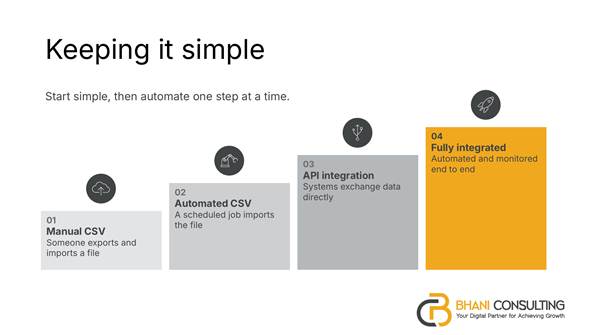
Start simple, then automate one step at a time.
Attendees who implement systems for a living agreed. A stepped approach limits change, and change is the hardest part of any system project. If you’re in the middle of an ERP implementation, bed that down first, then expand.
The one caveat: take small steps, but keep the big picture in view.
Treat integrations like products
An integration isn’t a one-off job. Like any digital product, it has a life cycle. You build and test it, you support and update it, and eventually you retire it. At every stage it needs one named owner. Without one, problems show up everywhere.
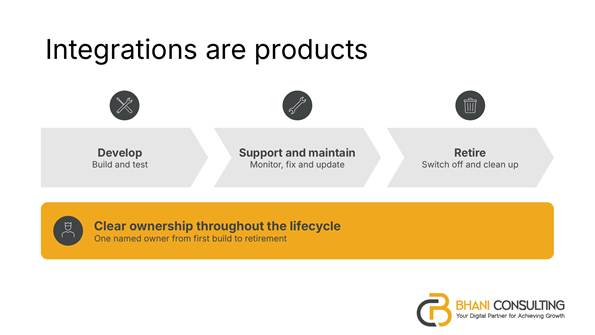
Every integration needs one named owner, from first build to retirement.
This came through strongly in the discussion. One attendee connecting two major systems said the hardest part wasn’t technical at all. It was working out who owns what, and where each process starts and finishes.
My suggestion was to run it as a proper project: a sponsor, a project manager, a simple charter that sets out scope and owners, and regular status reports. Once that structure is in place, people move towards an outcome because there’s a commitment. Another attendee added a practical tip: make integration its own workstream, so the right people are focused on it and ownership is clear before anything is built.
The takeaway
Integration is a discipline, just like project management or change management. If I had to sum it up in three lines:
- Give it an owner. Someone needs to be accountable for the whole picture.
- Start with a holistic view. Understand all your systems before you connect any of them.
- Then break it into small steps. Simple and steady beats big and tangled.
Messy integrations rarely come from one bad decision. They come from lots of small, sensible-looking steps that nobody stepped back to look at. If that sounds familiar, pause and look at the bigger picture before you add the next link.
SP Singh, Principal Consultant, Bhani Consulting
Our Lunch & Learn sessions run monthly and are free to attend. Join us for the next one, “Automate Quickly Without Losing Control”, on Wednesday 4 November 2026.