Picture the moment. You’ve spent months planning a new system or a new way of working. You present it to the team, and someone folds their arms and says, “That won’t work here.”
It’s tempting to see that person as the problem. In my experience, they might be the most useful person in the room.
That was the idea behind our September Lunch & Learn, “How to Lead Change When People Push Back”. Here’s what we covered, and why I believe resistance is something to welcome rather than fight.
What change management really is
Change management means different things to different people, so here’s what I mean by it. It’s a discipline where we understand our stakeholders and the scope of the change at a deeper level, work out how the change will affect each group, build a tailored journey for each one, and then lead from the front to help them move from where they are today to where the organisation needs them to be. It comes down to three things:
- Understand the people: their motivations, concerns and readiness for change.
- Map the terrain: what is changing, who is affected and what stands in the way.
- Lead the journey: communicate, support and embed the new way of working.
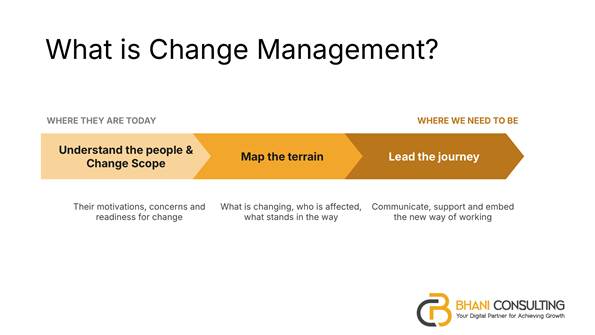
Change management guides people from where they are today to where the organisation needs them to be.
Three common myths
Change management is often mistaken for something it isn’t. Three myths come up again and again.
Myth one: change management happens near go-live. In reality, change starts before the project does, not at deployment. By go-live, it’s far too late to start listening.
Myth two: communications is change management. Newsletters and emails are useful, but comms is only one tool. Real adoption needs people to change how they work, and that takes more than a message.
Myth three: the job is to sell the change. People don’t adopt what they’re sold. They adopt what they help shape. Our role is to facilitate change, not push it.
None of these is wrong on its own. Communication and a bit of selling are both part of change management. The myth is treating any one of them as the whole thing.
The group added a few more. One attendee described business units saying “that’s not my job, that’s comms” when they were asked to help shape messages or provide testers. But only the people inside a team know the details of how it really works, so they have to own their part of the change. Another made the point that change can’t be outsourced. Bringing in a change manager doesn’t replace change leadership, which has to come from the executive team and be tied to a clear outcome, not change for change’s sake. A third reminded us that culture runs deep. People are used to their software, their processes and the people they work with, so the need for change has to clearly outweigh the resistance to it.
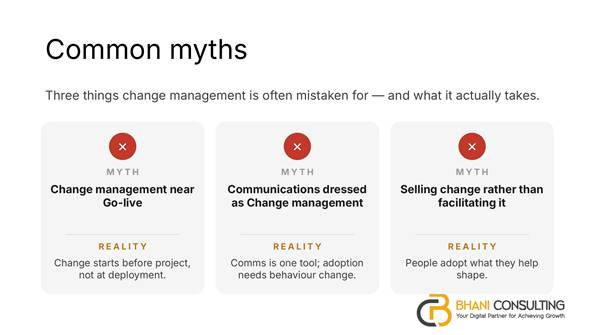
Three things change management is often mistaken for, and what it actually takes.
Resistance is not the villain
In most projects, resistance is treated as a roadblock, and the person behind it quietly becomes the villain. I’d like to turn that around.
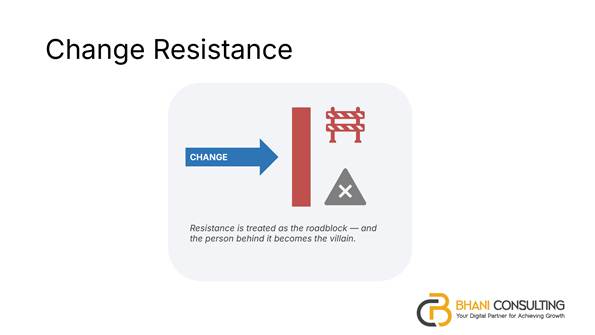
Resistance is often treated as the roadblock, and the person behind it becomes the villain.
Imagine three scenarios in your project:
- No resistance at all. Nobody pushes back, so nobody stress-tests the change. That sounds smooth, but it usually means people aren’t engaged, or aren’t saying what they think.
- Resistance at the end. Objections surface after everything is built. That means rework, delays and extra cost.
- Resistance throughout. People question and challenge the change all the way along. It’s harder work, but the result is a far more refined product.
Given the choice, I’d take the third scenario every time. The second is the most painful. You’ve spent the time, effort and money, everything looked fine for three quarters of the project, and suddenly half the organisation is pushing back when it’s too late to respond well.
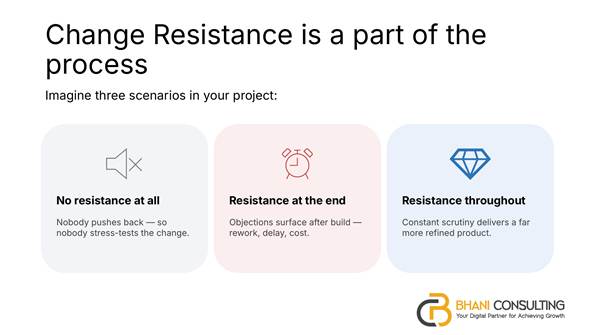
Of the three scenarios, constant scrutiny delivers the best result.
Why resistance is a good thing
When people push back, we get the chance to listen, understand and manage their concerns. The alternative is to fool ourselves that everyone has accepted the change, when they haven’t.
So when it comes to resistance:
- Sooner is better. Surface it early, while there’s still time to act.
- Clearer is better. A specific objection is much easier to deal with than a vague sense of unease.
- Wider is better. Hearing from more people shows you the real risks to adoption.
Put simply, hearing “no” is much better than watching people nod along.
One attendee asked a fair question: what about resistance that never surfaces? They described how it can escalate, from passive resistance like missed meetings, to vocal pushback, to people quietly letting something fail. In my experience, that escalation usually traces back to the very start. If we don’t identify stakeholders early, explain their role and give them a real way to be heard, the grumbling goes underground. People form groups, it becomes “us versus them”, and it starts to affect the culture. That’s why engagement needs to begin before the project does.
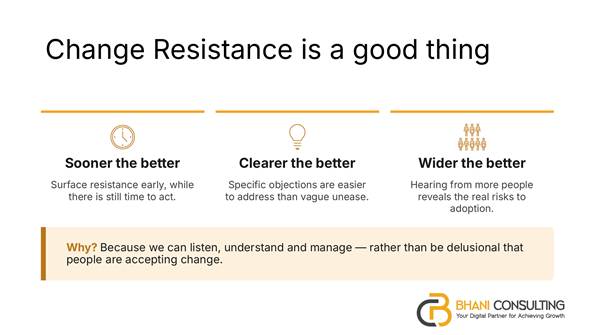
Resistance is a good thing: sooner, clearer and wider is better.
How to treat resistance
Resistance is information. The job is to invite it, hear it, and act on it.
- Encourage people to speak. Make it safe to raise doubts without consequences.
- Create ways to listen with an open mind. Forums, surveys and drop-in sessions work well, as long as they’re structured rather than ad hoc.
- Do something with what you hear. Act visibly, and tell people what changed because of their input. Nothing builds trust faster.
Here’s a simple example. Someone says, “The new accounts receivable process is rubbish.” That’s vague, so we ask them to show us. Which screen? What used to work that doesn’t now? Once we understand the real issue, we act, perhaps by bringing in a business analyst to work through it with them. We acknowledged the problem, clarified it and did something about it. And now that person is on the change team rather than fighting it.
It sounds like common sense, but too often change teams work separately from the business rather than hand in hand with it. That’s when passive-aggressive behaviour creeps in.
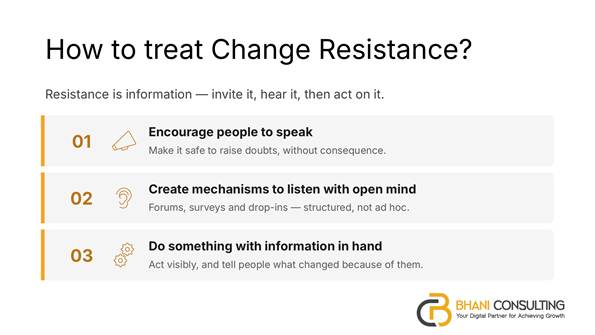
Resistance is information: invite it, hear it, then act on it.
Why people resist change
I say “we” deliberately, because none of us is immune. People rarely resist the change itself. They resist what it costs them. Usually that cost takes one of three forms:
- Unease and extra work: new ways of working mean effort on top of the day job.
- Risk: fear of failing, or of being exposed as not knowing how to do something.
- Loss: of status, routine, relationships or control.
Once you see resistance this way, it stops looking like stubbornness. It starts looking like a reasonable response that you can plan for.
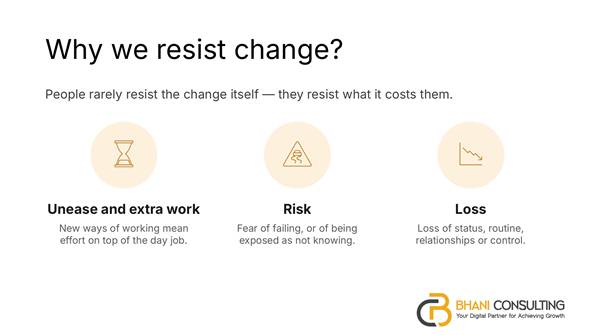
People rarely resist the change itself. They resist what it costs them.
Turning resisters into champions
Champions aren’t appointed. They’re earned, one stakeholder group at a time. The path looks like this:
- Step 1: understand your people, your environment and the change at a deeper level.
- Step 2: understand the impact of the change on each stakeholder group.
- Step 3: develop a tailored transition plan for each group.
Finance staff, frontline teams and managers will each feel the change differently. A single plan for everyone rarely works for anyone. This takes longer, but it’s the right way to do it.
This isn’t theory. In implementations I’ve led, I’ve started with groups that felt quite disjointed. Once we put in the effort to understand them in detail, people could see we were listening and had a plan to help them. Trust followed, and they became part of one inclusive team.
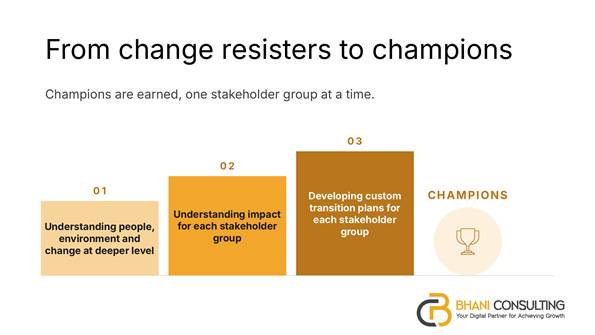
Champions are earned, one stakeholder group at a time.
Honour values, not tricks
There’s no clever technique that replaces genuine trust. Plenty of software rollouts are launched with rocket ships and big promises to create excitement, and people have learnt to see through it. What works is living by three values: transparency, empathy and authenticity. Be open about what you don’t know yet. Understand people’s perspectives rather than labelling them as resisters. And don’t pretend to have every answer.
When people see those values in action, trust follows. And trust is what connects people and gets them working towards a common goal.
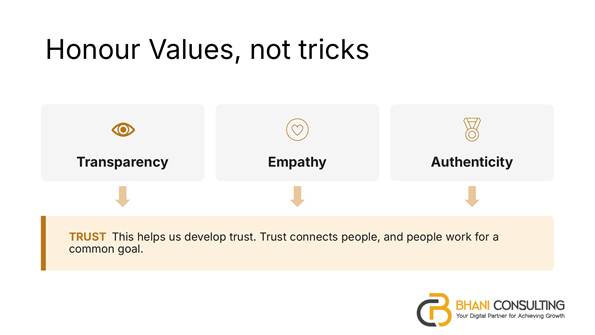
Transparency, empathy and authenticity build the trust that change depends on.
A word on change fatigue
The liveliest part of the discussion came at the end, on change fatigue. One attendee described constant change with no end in sight, where people feel the goalposts keep moving and resistance builds on itself. Another said AI tools have made it worse. Every department now has new ideas for workflows, and requests to change processes arrive several times a day, often before anyone has thought them through.
I compared it to two approaches to fitness. One is to go flat out, burn yourself out and then take a break. The other is to train every day at about 80% and build volume over time. Change works better the second way. When we rush one initiative after another without planning for sustainability, people burn out.
Another attendee made a sharp point about culture. Organisations that handle change well reward effectiveness, not busyness. They have a clear vision, strategy, budget and roadmap, so every change has a purpose people can point to. Without that anchor, it’s hard to prioritise anything. As they put it, AI can make you ineffective a lot more effectively. Their advice was to start by asking what each change is for, what outcome it delivers and how it will be measured. If nobody can answer, that’s the first thing to fix.
The takeaway
If I had to sum up the session, it would be these six points:
- Change management is a holistic discipline, not something you do at the end.
- It is not communication management.
- Hearing “no” is much better than people nodding.
- Understand your people, your environment and how the change affects them.
- Plan and prepare for each stakeholder group.
- Live by your values to win trust.
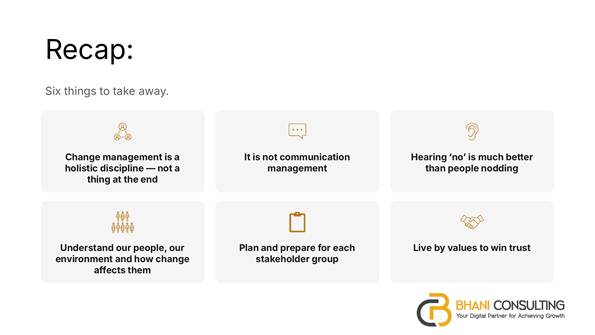
Six things to take away.
Change management is a discipline, and we can’t remove ourselves from the people we serve. We shouldn’t label others as change resisters and ourselves as change heroes. Resisting change is simply human. It all starts with an honest conversation, and the sooner you have it, the better. Ideally before the project even begins.