
How to spot the red flags and fix the real cause
When an ERP project starts to wobble, the usual response is to add more: more budget, more people, more time. It feels like action. In my experience, it rarely fixes anything.
That was the theme of our June Lunch & Learn, “How to Fix a Failing ERP Project”. Here’s what we covered, along with some hard-won lessons from the people in the room, many of whom have spent decades implementing and rescuing ERP systems.
Three projects, three ways to get stuck
To start, I shared three fictional companies. The names are made up, but the patterns will be familiar to anyone who has worked on an ERP project.
Rivervale: the UAT deadlock. Initiation, design and build all reported green. The status reports were full of smiley faces. Then user acceptance testing started, and it fell apart. Testers said the system didn’t fit their needs and was full of bugs. Suddenly the board was looking at change requests, budget and time overruns, and a request for more resources.
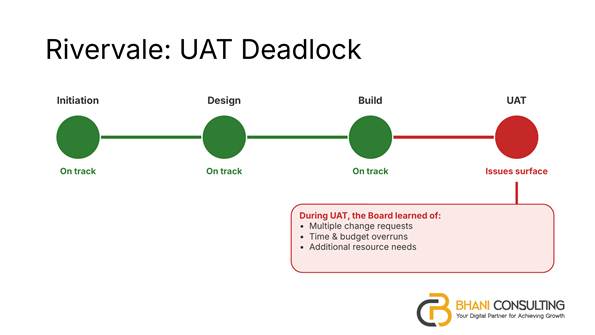
Rivervale: everything is green until UAT.
Playpat: the custom build blunder. Playpat had a bespoke system built up over 30 years, which was no longer supported. They chose a flexible ERP and started customising it to work like the old system. Eight months in, the project was re-estimated. Phase one alone would need three times the original budget.
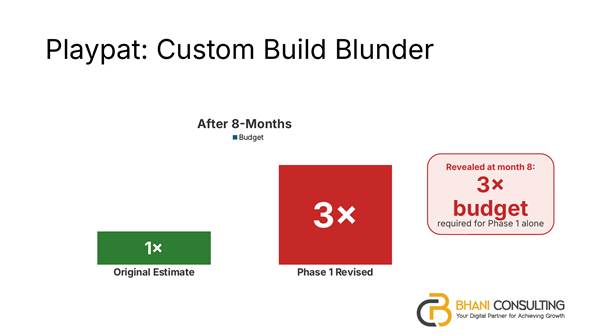
Playpat: three times the budget for phase one alone.
Jamjin: the siloed fracture. The managing director signed off the ERP and handed it to finance to run. Two years later, finance was using the system well. Everyone else, from operations to sales to HR, was still doing things their own way.
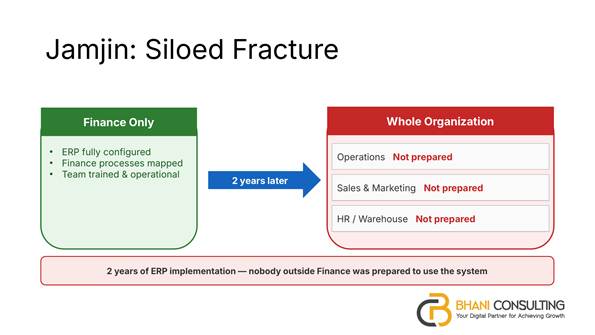
Jamjin: two years in, nobody outside finance was ready to use the system.
In all three cases, adding more budget or resources wouldn’t solve the problem, because the problem wasn’t a shortage of either.
The group added two more patterns they see often. One attendee, who works for an implementation partner, described projects delivered as a minimum viable product, where much of what users need never arrives. Six months after go-live, people discover the gaps, and his team gets calls every month to rescue them. Another attendee described a procure-to-pay system chosen by management without talking to the staff who actually do the work. The result wasn’t fit for purpose and didn’t have staff support.
What does “failing” actually mean?
For our discussion, an ERP project is failing when you see one or more of these signs:
- The investment outweighs the value. Costs far exceed the returns you expected.
- Relationships turn bitter. Trust breaks down between departments, teams, or customer and vendor.
- You hit dead ends. You keep putting in effort, but there’s no clear path to recovery.
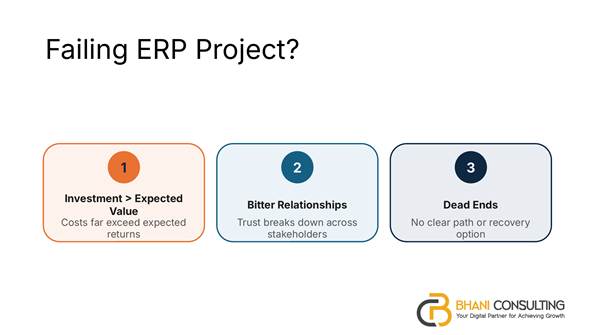
Three signs of a failing ERP project.
Failing isn’t a yes-or-no state. It’s a spectrum. On any ERP project, some things are going well and some are going wrong, right now. What shifts you along that spectrum is the quality of your decisions.
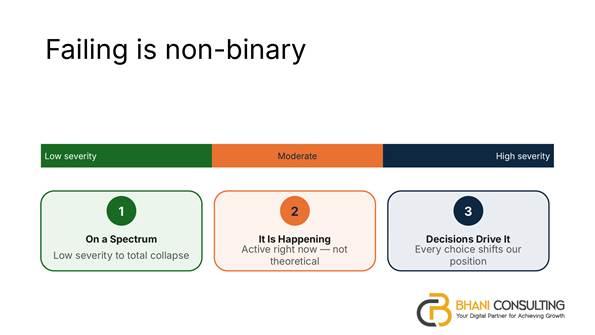
Failing is a spectrum, and decisions drive where you sit on it.
Why failure is so hard to see
While you’re in the middle of a project, failure is invisible. Above the waterline, you see activity: people are busy, invoices are signed, milestones and checklists are ticked. It feels like progress.
Below the waterline are the decisions you made: the product, the partner, the people leading the work. If those decisions were wrong, all that activity is simply carrying you towards the wrong destination.
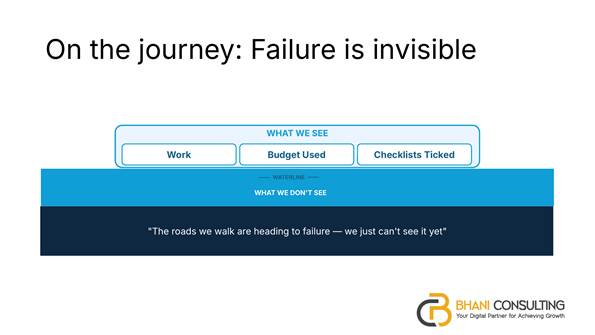
Above the waterline we see activity. Below it sit the decisions that decide the outcome.
Looking back, it’s usually obvious. Bad decisions made on incomplete information. Decisions that were never made, or sat waiting for months. And a lack of governance, so everything was handled ad hoc.
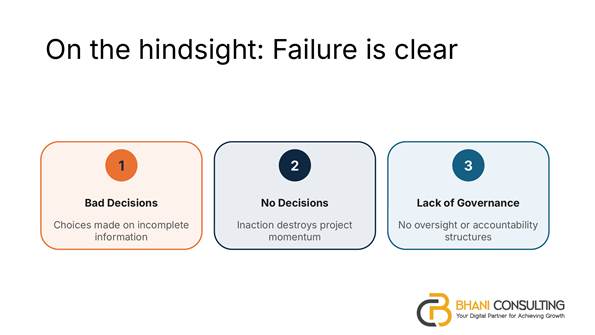
In hindsight, failure is clear.
One attendee, a long-time implementation partner, said this is why project management and governance are the cornerstone. It’s a business project, not an IT project, so the business has to drive it. That means clear, challenged requirements, real support from the executive team, and the right people from the business on the project. Those people need their day jobs backfilled, not split between two roles. Invest that money up front, he said, or it will come back to bite you.
Another attendee added that how you set up the program is the one thing you can’t recover from. Replace every system that’s been in place for a decade in one go, and you’re looking at a two-to-five-year transformation, not an implementation. How you split phases and scope, and how you build your team and governance, has to match the size and complexity of your organisation.
Five red flags to watch for
- No news. If you’re not hearing anything about the project, that isn’t good news. Go and find out what’s happening.
- Governance theatre. Steering committee meetings where the project team tells a rosy story and everyone nods. A real steering committee is a safe place where members come prepared, raise concerns, ask hard questions and make the decisions put in front of them.
- Old foundations. Building the new system to mirror the old one, as Playpat did.
- Too simple. Anyone who calls an ERP implementation a piece of cake. Even small implementations are complex by nature.
- No accountability. Nobody clearly owns the project, project management, change, data or testing. Accountability needs to be set at the start, in the project initiation documents.
Six common reasons behind them
Those red flags are symptoms. Underneath them, I usually see one or more of six causes:
- Wrong product: a system that isn’t fit for purpose.
- Wrong partner: an implementer without the right experience.
- Go-live rush: an arbitrary date that everyone rushes to meet.
- No architecture: no clear picture of how the ERP will work with your other systems, such as service portals, the website, bespoke applications and Microsoft 365, from both a technical and a business point of view.
- Ignoring the basics: project management, change management, data migration and testing.
- No leadership: decisions made ad hoc, with nobody accountable.
The real root cause: bad decisions
Trace those six causes back, and they all lead to the same place. Choosing the wrong product, choosing the wrong partner, skipping architecture, leaving accountability unclear: each one is a decision.
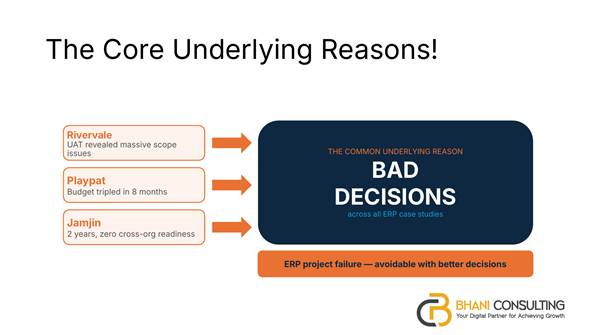
Three very different projects, one common underlying reason.
No executive sets out to make bad decisions. So why are they so common? I think the answer lies in the four stages of competence. Think of learning to drive. As a small child, you think driving is easy, because you just turn the wheel. You don’t know what you don’t know. Later, you realise there’s a lot to learn. Then you learn, but it takes real concentration. Eventually, you drive without thinking about it.
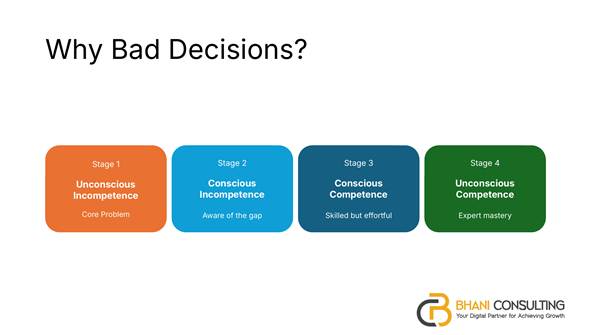
The four stages of competence.
With ERP, I believe many decision makers are caught in the first two stages. Many have never been through an implementation, so they’re led to believe that once the contract is signed and a team is in place, it should be fine. Or they see a gap, hire a data migration specialist or a business analyst, and stop there, without looking at the bigger picture of architecture and governance.
Here’s a comparison I find useful. Imagine three projects of the same size, say half a million dollars each: a civil construction project, a manufacturing project and an ERP implementation. For the first two, we’d never hesitate to hire qualified engineers with the right certifications and experience. For ERP, we often assume someone in IT who knows software, or someone in finance who knows the chart of accounts, can lead it. That’s the gap.
One attendee put it well: we call it an ERP project, but it’s really a business transformation. The person leading it needs to be empowered to make decisions, and the people closest to the detail need a way to turn what they know into better decisions. He also pointed to a big accelerator: choose a partner with a proven template for your industry. He once implemented a system for a multinational in 10 to 12 weeks because he was replicating something that already existed. Having the answers to the homework for your sector makes a massive difference.
The bulletproof checklist
Wherever your project is at, these seven questions show you where you stand. If you can’t answer them, you have a problem.
- Why: do we know the reason for this ERP implementation?
- Who: have we identified all stakeholders and their roles?
- What: have we documented the scope, business case, charter and architecture?
- Which: have we selected the right ERP product and implementation partner?
- Who: have we formed the right internal project team?
- How: have we engaged leadership and set up proper governance?
- How: have we agreed a project plan, reporting and acceptance criteria?
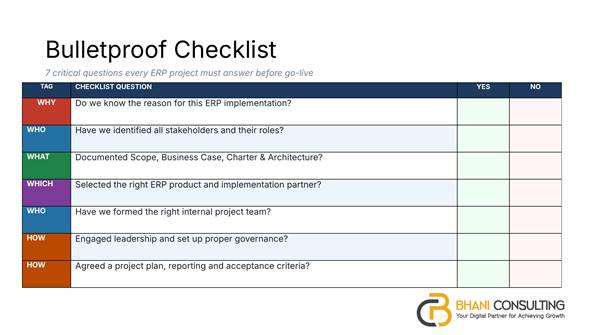
Seven questions every ERP project must answer.
A few final words from the group
The discussion at the end was frank. One attendee observed that failed implementations are far more common than people admit, and that products are sometimes chosen for the wrong reasons. In his experience, buyers spending under $500,000 tend to decide on price, and above about $1.5 million risk becomes the main factor. Most projects sit in between, which makes due diligence on product and partner essential. He also said the onus is on implementation partners to be honest: if the scope isn’t clear, say so or walk away, and if you get something wrong, take it on the chin and fix it. An ERP implementation is a long-term relationship built on trust and transparency, not a job you finish and leave.
Another attendee raised something you rarely see in the textbooks: the courage not to start. Before you even go to tender, review your foundations and make a genuine go/no-go decision. If the organisation or the technology isn’t ready, a project set up to fail is a lonely, uphill fight from day one.
The takeaway
- Failure is happening. On every project, to some degree. Accept it and look for it.
- Look for the red flags. No news, governance theatre, old foundations, “too simple” and no accountability.
- Work on the root cause. More money, more people and more time won’t fix a wrong product, a wrong partner or inexperienced leadership. Better decisions will.
ERP projects rarely fail for lack of effort. They fail because of the decisions underneath the effort. Get those right, and the work has a chance to pay off.