
Why most digital roadmaps miss strategy, and how to fix it
Most organisations have a roadmap. It might be an ICT roadmap, an ERP roadmap or a product roadmap. There’s usually a colourful slide with timelines and milestones, and everyone is busy delivering it.
The problem isn’t that we don’t have roadmaps. It’s that most of them aren’t strategic.
That was the theme of our May Lunch & Learn, “Why Most Digital Roadmaps Miss Strategy, and How to Fix It”. Here’s what we covered.
Three familiar characters
To make the point, I introduced three cartoon characters. You may recognise them in your own organisation. I certainly recognise one of them in myself.
He-Man sits on decisions. Key decisions get parked for tomorrow, and then suddenly everything becomes urgent. Picture an executive team that knows its ERP will be out of support in two years. It’s discussed, but no formal decision is made. A year and a half later, it’s a scramble to pick a new system and go live in six months. There is a roadmap, but it’s driven by urgency, not importance.
Spider-Man wants to look good. Someone new joins the organisation and wants AI, business intelligence and every emerging technology, without first understanding where the organisation is or what its business goals are. The roadmap is built around the cool stuff, not what matters.
Mickey Mouse goes with the flow. Do the next thing, follow what everyone else is doing. The roadmap is built on consistency with others, not on what’s important to the organisation it serves.
There are more archetypes than these three, and we all have some of these traits. I’ll own mine: I have a tendency to sit on decisions and then rush when everything feels urgent. It’s worth a little honest self-reflection.
Busy, but not getting far
When roadmaps are based on urgency, appearances or habit, the result is the same. Everyone is busy. It looks like progress. But it’s like moving around a maze: lots of activity, without getting very far, because time and money aren’t going into the things that matter most.
So why bother with a strategic roadmap? Because meaningful progress needs one. It gives you a baseline to measure progress against, so you can see where you’ve drifted and correct course in a direction you chose on purpose. Our success depends on it.
The three building blocks
Here’s a simple framework. It works for any roadmap, whether it’s for ICT, ERP, a product, a career or even your life. It’s a framework rather than a rigid procedure, built on three blocks:
- Knowing ourselves: understanding who we are, what we have and where we want to go.
- Making strategic decisions: choosing a direction with clarity, including what we’ll say no to.
- Developing a plan: the roadmap itself, built on the first two steps.
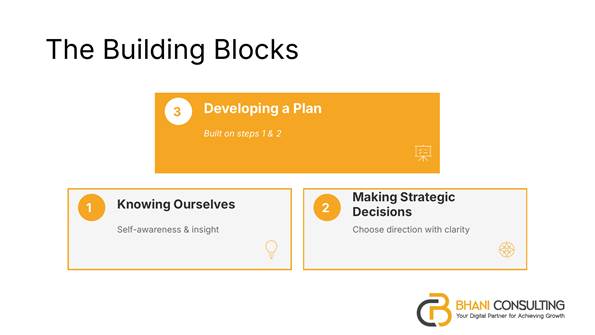
The three building blocks of a strategic roadmap.
Step 1: Know yourself
Start with a holistic view of your organisation. Pick a few dimensions, for example business goals, people and culture, and technology. You could use five or ten, but three keeps it simple. Then look at each through three lenses: past, present and future.
For business goals, that means asking: what were our vision, objectives and priorities in the past, and how well did we achieve them? How often did they change? Where are we now? And where do we want to be? Repeat this for people and culture, and for technology.
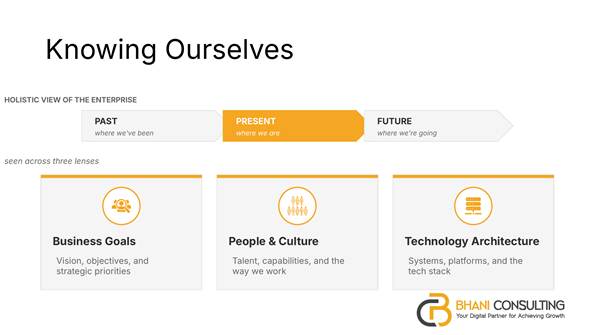
Knowing ourselves: three dimensions, seen through past, present and future.
Many planning exercises only look at the present and the future. Some only look at the future. I think the past matters a great deal. If nothing changes, whatever happened before will happen again. That’s simply human behaviour.
Step 2: Make strategic decisions
Strategy is as much about what you say no to as what you say yes to. On the no side: the outcomes you want to avoid, the activities you’ll limit, and the guardrails you’ll set. An organisation might decide not to expand beyond Australia, or to avoid adding more middleware. On the yes side: the strengths and opportunities you’ll pursue, and the risks you’ll actively manage.
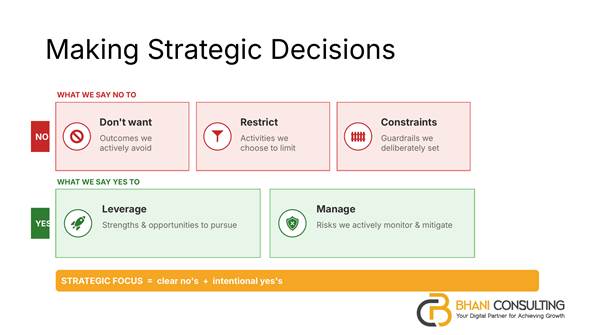
Strategic focus means clear no’s and intentional yes’s.
Saying no is the hard part. Here’s an honest example. When our team asked me which social media channels to focus on, my instinct was: why not all of them? Facebook, Instagram, everything. But that’s exactly the problem. If our audience is on YouTube and LinkedIn, the strategic choice is to focus there and say no to the rest. That’s all strategy is: clear no’s and intentional yes’s, facilitated with your decision makers.
Step 3: Develop the plan
With a clear view of yourself and your strategic decisions made, the roadmap comes from six inputs:
- Where we are (current state)
- Where we want to be (target state)
- What we have (assets, resources and skills)
- Our constraints (from the decisions in step 2)
- What it takes (the initiatives that will get us there)
- Dependencies (what has to happen first, and what can run in parallel)
Then you draw, refine and validate the roadmap. Working out dependencies, whether technical, resource or budget, is where the real art of roadmapping lies.
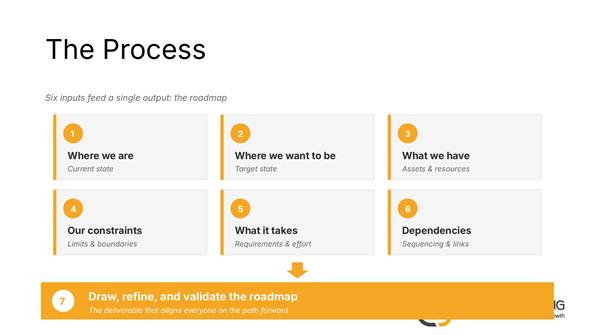
Six inputs feed a single output: the roadmap.
An example: Northbridge Health
To make it concrete, here’s a fictional healthcare organisation, Northbridge Health. Looking at its past, present and future, it is moving from reactive, siloed services towards value-based care. Its people are moving from paper-first habits towards data-literate teams. And its technology is moving from a legacy, on-premise system towards a cloud-based, interoperable platform.
Its strategic yes’s include a cloud-based patient records system, co-design between clinicians and IT, and interoperability standards. Its no’s include new on-premise builds, custom one-off integrations and paper workflows.
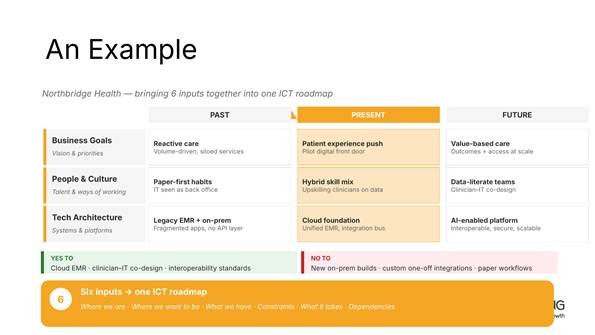
Northbridge Health: bringing the inputs together.
From there, the roadmap sequences initiatives across each workstream into now, next and later, with clear milestones. Every initiative ties back to a strategic yes, and is funded, staffed and aware of its dependencies.
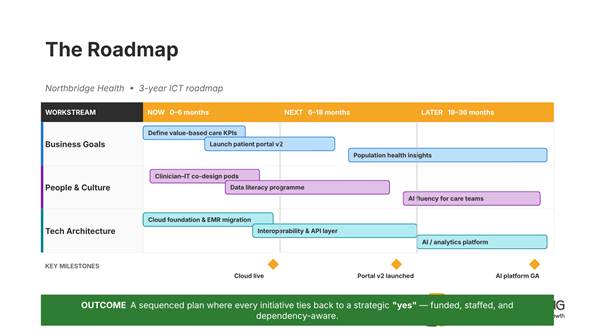
A three-year roadmap where every initiative ties back to a strategic yes.
What the group added
One attendee, who runs an allied health practice, shared that they already build roadmaps for each practitioner’s personal and professional growth, alongside quality improvements and new technology. They were keen to bring the strategic lens to those roadmaps.
Another attendee, a developer, said the session made them think about looking at the past for teams, too. If someone in a team can’t grow because their scope is too narrow, looking back helps you see what’s missing. I agree. It’s one of the reasons interviews include behavioural questions: if nothing changes, the past tends to repeat itself.
An attendee with long ERP experience asked whether anyone had found a roadmapping tool that really works, as the ones they’d tried hadn’t lived up to expectations. They also found the framework simple enough to use across a whole organisation. If you have a tool you’d recommend, we’d love to hear about it.
The takeaway
- Roadmaps are everywhere. Products, ICT, careers and life all have them.
- Most are decided for us. When we go to school, when we can access super, how careers progress, how vendors update their software. These roadmaps are already set, even if we don’t see them.
- The important ones must be designed by us. For the roadmaps that matter to you, don’t just accept what you’re given. Roll up your sleeves, understand where you are, and design a roadmap that makes real progress.