How to prepare your processes so ERP doesn’t break them
Picture the start of an ERP project. The business case is approved. Your current processes are a tangle of manual steps and spreadsheets, and nobody can quite pinpoint where the problems are. So the decision is made: “We’ll just go with out-of-the-box processes.”
It sounds sensible. But ask five people what “out of the box” means and you’ll get five different answers. That confusion is where a lot of ERP value quietly leaks away.
That was the focus of our April Lunch & Learn, “Prepare Your Processes So ERP Doesn’t Break Them”. Here’s what we covered.
Why should we bother?
Think about Amazon and eBay. Uber and a traditional local taxi company. IKEA and a typical local furniture store. You might say the first in each pair is bigger, or more high-tech, and you’d be right. But that’s not the fundamental difference.
The real difference is the process. Ordering a car through Uber is a completely different experience from calling a taxi. Amazon’s process, from browsing to the parcel arriving at your door, is designed end to end. Walking through IKEA, picking your items and loading them into the boot is a process someone has thought through carefully.
Technology is the enabler. It lets these companies run good processes at scale. A good process supported by great technology is what makes the difference.
The flip side is just as telling. We’ve all dealt with big organisations running big, expensive ERP systems whose products and services are still miserable. The software didn’t fix them, because the processes underneath weren’t right.
Three myths worth questioning
Three phrases come up again and again in ERP projects:
- “We’ll use out-of-the-box processes.”
- “We’ll adapt and adopt the standard ERP processes.”
- “We’ll map your as-is and to-be processes, and the ERP will deliver the to-be.”
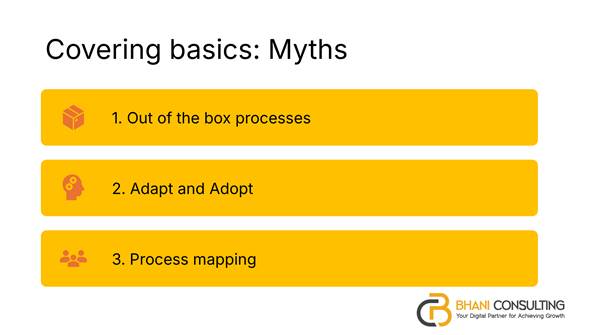
Three common myths about processes in ERP projects.
Let’s start with the third. If someone offers to map all your current and future processes as part of the ERP implementation, be cautious. You may not need all that work. If you do it alongside the ERP, you’re quietly doubling your scope. And in practice, organisations get tired of running both at once, so the process improvement work is usually dropped and the ERP goes live without it.
ERP implementation is one project. Process improvement is another. They can run in parallel, but only if you plan and scope them that way. It won’t just happen.
What do we actually mean by “process”?
To make sense of the first two myths, it helps to see that “process” means three different things, at three different levels:
- Layer 1, value chain: the end-to-end business flow, owned by business leadership. For example, request to service to cash: a customer requests a service, you deliver it, invoice them and get paid.
- Layer 2, process: the defined steps within that flow, owned by functional leads. For example, intake, service delivery, revenue and governance.
- Layer 3, ERP transactions: what happens in the system, owned by finance or IT. For example, creating a service request, raising a work order or receiving a payment in accounts receivable.
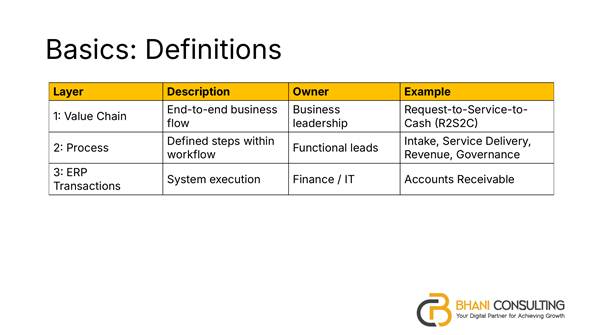
Three layers of process, each with a different owner.
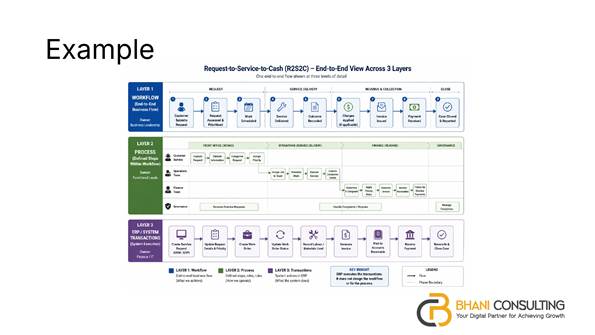
Request to service to cash, viewed across all three layers.
Here’s the key point. When someone says you’ll adopt out-of-the-box ERP processes, they almost always mean layer 3: the transactions. And that’s fine. There’s no reason to reinvent how you raise an invoice or receive a payment. Go with what the ERP offers.
But layers 1 and 2, the end-to-end flow and the steps within it, aren’t covered by default. Organisations often assume that once the ERP is live, the processes are sorted. They’re not.
Get clear before you start
Three things will save you a lot of pain:
- Agree what “process” means. Make sure everyone understands the three layers before the project starts.
- Decide how you’ll handle process management. Who owns it, and what’s in and out of scope for this project?
- Write it down and get it approved. Set a baseline plan the executive team signs off.
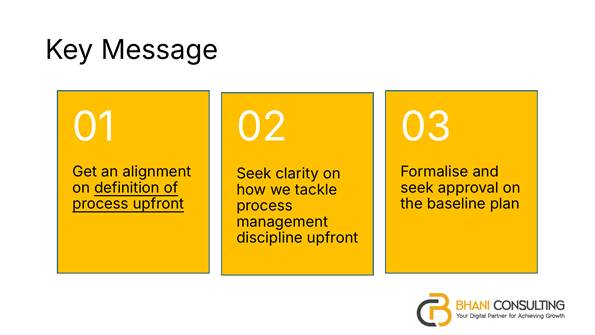
Three key messages to settle before the project starts.
The plan can be simple. For example: document the end-to-end value chains (layer 1). In phase one, use basic, minimum viable processes (layer 2). In phase two, improve and optimise them. Use out-of-the-box ERP transactions throughout (layer 3). That one paragraph gives everyone, including executives, a clear picture of what “out of the box” means for your project.
Seven process hotspots
Process management isn’t easy. These are the seven hotspots where I most often see it go wrong:
- Ownership ambiguity: who owns the end-to-end outcome? Hint: it isn’t your IT manager or your ERP manager.
- Shadow processes: where is Excel really running your business? People come and go, and they build their own workarounds alongside the ERP.
- Process variation: three teams doing the same work three different ways.
- Decision gaps: who decides which process to follow, and on what basis?
- Data breakdown: if data is inconsistent or statuses aren’t updated on time, you can’t make sound decisions about improving a process.
- Exception handling: what happens when things go wrong, and how are edge cases managed?
- Visibility: how can you see whether the process is actually being followed and working end to end?
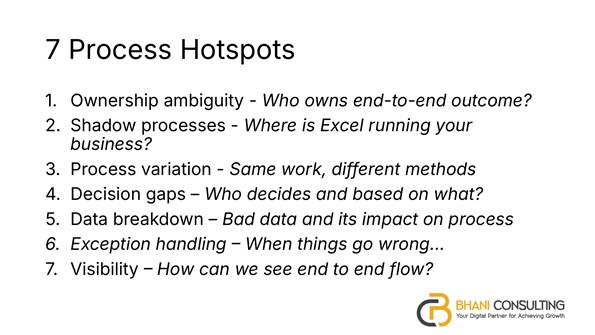
Seven hotspots that make process management hard.
Two actions I’d suggest. First, assess your organisation or project against these seven hotspots and note where your risks are. Second, run a spreadsheet audit. Find every spreadsheet that finance, operations, sales and other teams use to manage work outside your systems. I think you’ll be surprised how many there are.
Where to start
Process management is a discipline, so it needs its own process. Here’s the simplest version I can offer:
- Build a process library. List all your value chains and processes in one place, even just a big spreadsheet. You don’t need to start from scratch: an AI tool such as ChatGPT can give you a solid first draft for your sector, which you then refine.
- Appoint a process management owner. Someone responsible for process improvement across the organisation. It isn’t tied to the ERP. It starts before the ERP and never ends.
- Set a mandate and governance. At executive level, define the role and responsibilities of the discipline, and how you’ll check it’s actually happening.
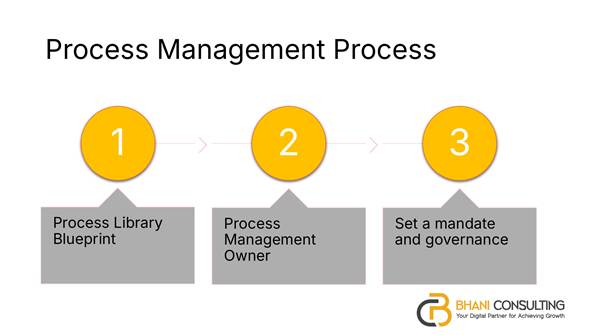
A simple process for managing process management.
I stress this because it’s so rarely discussed. Many organisations assume the job is done once the ERP is live. But process management starts before the implementation and keeps going after it. I believe its absence is one of the main reasons organisations don’t see the return they expected from their ERP investment.
A question about customisation
In the discussion, an attendee with ERP consulting experience made a good point. If you don’t adapt and adopt the standard processes, you open yourself up to customisation. In modern cloud systems that’s less catastrophic for upgrades than it used to be, but it still moves you along the risk curve, and change management becomes critical.
I agree, and I’d add one distinction. Ask why you’re customising. If it’s because staff want the new system to work exactly like the old one, that’s really change resistance, and it’s rarely worth the cost. If it’s part of a genuine process improvement, the investment may well pay off.
Another attendee, a business owner preparing for an ERP as his company grows, asked what customisation costs. It depends on many variables. Modern ERPs let business users personalise screens and build simple workflows themselves, with drag-and-drop tools and no code. That’s great for small organisations, though larger ones need some governance so changes don’t become haphazard. Costs rise when you need scripts that someone has to maintain, or integrations that involve APIs. Overall, though, the cost of customisation has come down a lot.
The takeaway
- Process management is a discipline, not a task. It needs an owner, a mandate and a plan.
- It starts before the project. Whether you’re thinking about an ERP, implementing one or already live, process management should already exist.
- It ideally never ends. ERP is a tool to help you improve your processes. It isn’t the end goal.
Before you sign off on “out of the box”, make sure everyone knows which box you’re talking about.