
How to fix outdated processes with what you already have
Finance buys a new tool. Then operations buys one. Then supply chain, then quality. Each purchase makes sense at the time. A few years later, the organisation is paying for dozens of systems that don’t talk to each other, and nobody is quite sure what they all do.
Ask the people involved and they’ll usually sum it up in two words: “It’s a mess.”
That was the starting point for our July Lunch & Learn, “Fix Outdated Processes Without Buying New Software”. Here’s what we covered, and what the group added from their own experience.
The software shopping trap
It usually goes like this. Departments go solo, each rolling out its own system. Add-ons get bolted on along the way. Other departments follow the same pattern. Systems are rarely configured well or integrated, and as people come and go, the newcomers aren’t trained properly and start working around the system.
The result is ballooning costs, duplicated work and no single source of truth. And it all starts with small, sensible-looking decisions at department level.
The software shopping trap: small department decisions that add up to a mess.
One attendee, a CFO who also sits on a local council, said this rang true, especially in local government. Each area has its own budget and sign-offs, so nobody sees the full picture. He once asked for a report listing every software subscription the organisation paid for. It was frightening, he said, and very little was done with it.
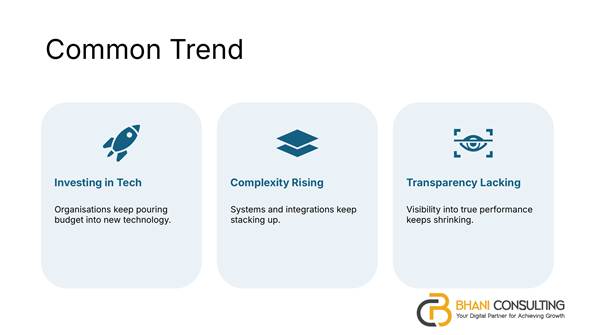
The pattern is common in medium-sized organisations. They are investing in technology. But complexity keeps rising, visibility keeps shrinking, and the total cost of ownership goes up while the benefits go down. Doing anything new becomes hard because nobody knows exactly what systems exist, what they run on or how they connect.
Organisations keep investing, but complexity rises and transparency falls.
Why it happens
I see three main reasons:
- SaaS and AI are everywhere. There’s a subscription for every business problem. A manager signs up, the team starts using it, the manager moves on, and the next person starts their own journey. Nobody manages or maintains these tools as assets.
- Decisions are decentralised. Finance thinks about finance, supply chain thinks about supply chain. Each silo makes software decisions for itself.
- Speed beats discipline. Everyone knows there are boxes to tick before buying software, but that takes time. So we say, “It worked at my last job, let’s just get it.”
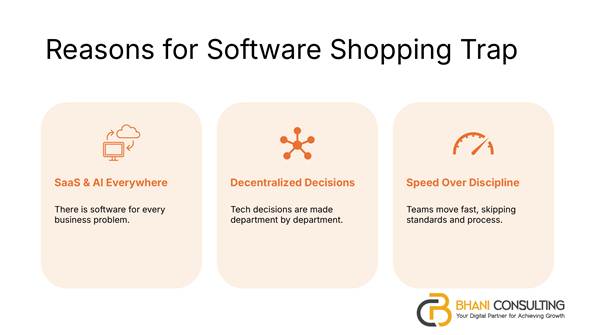
Three reasons organisations fall into the software shopping trap.
The group added more. One attendee with more than 50 years in IT and business pointed to poor database design. Another, who has worked in government, described departments being merged and split again over the years, picking up more data debt and software debt each time. A third said people often push for the system they used in a previous role, without thinking about what would work across the whole organisation.
Another attendee raised the social side. IT teams often create procurement processes that feel restrictive, while a company credit card offers an easy way around them. People rarely see the true total cost of ownership of what they’re buying. And one attendee with a long career in mining, oil and gas sales described how operating sites, frustrated by central IT bureaucracy and driven by their own KPIs, eventually took their IT budgets back, and head office lost control. The answer, he said, is balance: enough structure and coordination without slowing everything down.
The fix: three pillars
Buying more software won’t fix this. Fixing the process will. I see three pillars:
- Architecture: start with the end in mind, taking a top-down approach to technology decisions.
- Continuous improvement: get the most out of the software you already have.
- Process improvement: think end to end, improve the process first, then automate it.
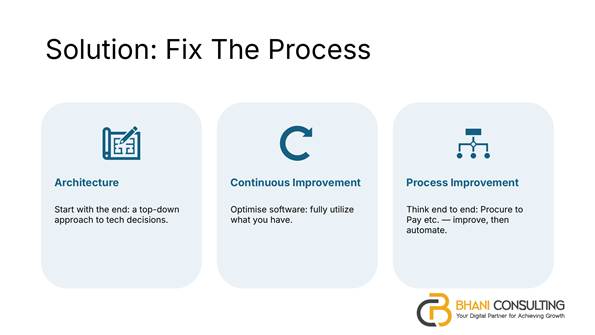
Three pillars for fixing processes without buying new software.
This doesn’t mean departments can never buy software. It’s fine to be decentralised, as long as these three pillars are in place, so every decision fits the bigger picture.
Pillar 1: Architecture
If you’re building a house and everyone builds their own room without a plan, you’ll end up with a mess. You need a blueprint first. The same goes for your technology.
Business architecture gives you clarity on strategy and direction. Are you growing, through acquisition or organically? Are you consolidating? It also maps your business capabilities, your end-to-end value streams and processes, and how the organisation is structured and governed.
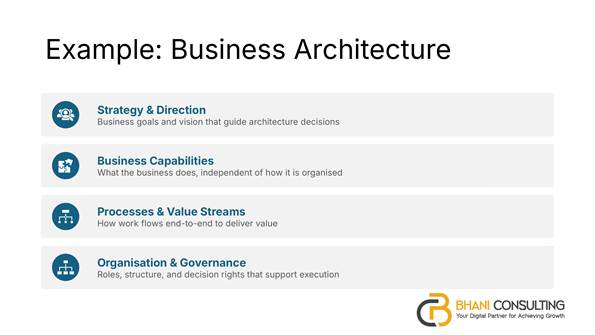
Business architecture: the blueprint for how your organisation works.
Systems architecture shows how your systems fit together across the presentation, application, data and infrastructure layers. So when someone wants to buy something new, you can see how it will connect with everything else.
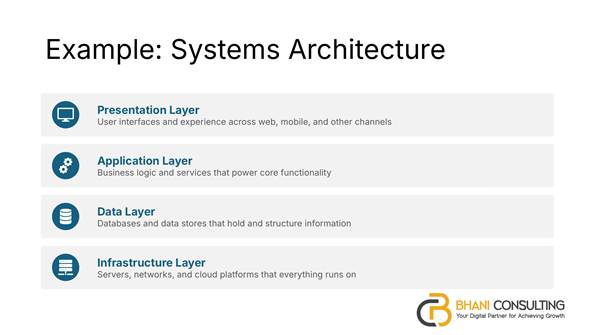
Systems architecture: how your technology hangs together.
A word of caution: architecture can go wrong at both extremes. Sometimes an architecture team draws diagrams that nobody looks at again. At the other extreme, every decision has to go through them. You need a balance, where teams can still make their own decisions with support and guidance from the architecture.
Pillar 2: Continuous improvement
The premise is simple: fully use what you already have before you buy anything new. That starts with ownership at three levels:
- System owners keep platforms up to date, make sure new staff are trained and roll out enhancements on time.
- Data owners are accountable for data quality, security and access across the organisation.
- Process owners are accountable for how end-to-end processes perform and improve.
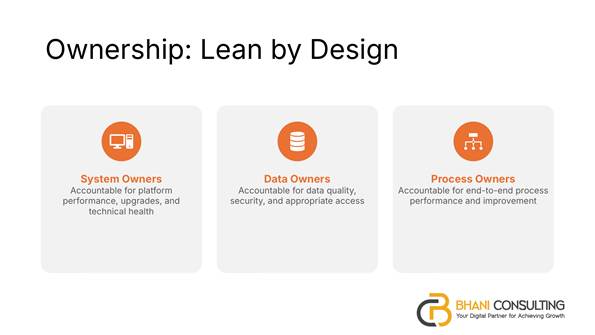
Ownership at three levels makes continuous improvement possible.
With owners in place, you have people to consult and hold accountable. Then set KPIs so you can tell whether you’re improving or going backwards. Useful ones include cycle time, error rate, cost per transaction and customer satisfaction. Pick the ones that suit your organisation.
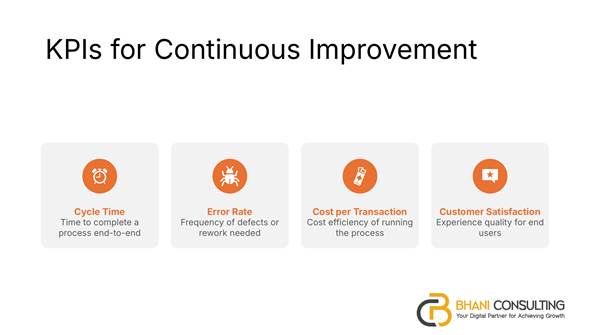
KPIs that show whether continuous improvement is working.
Pillar 3: Process improvement, end to end
Process improvement isn’t about making one department faster. It’s about the whole flow. Take source to pay: procurement handles sourcing, requisitions and purchase orders, and finance handles payment at the end. Order to cash involves sales, operations and finance. Hire to retire runs across HR, managers and payroll.
When each team only improves its own piece, the handovers between teams are where things break. The real value for your customers sits in the end-to-end view. Improve the process first, then automate it.
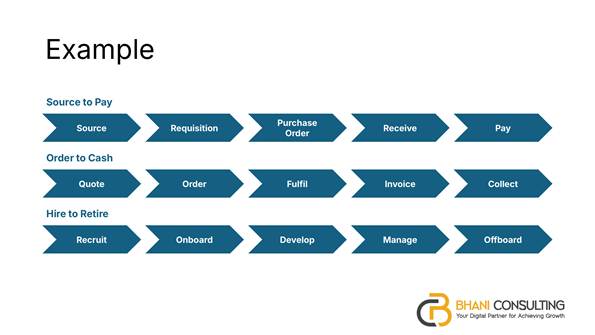
Look at processes end to end, across every team involved.
What the group added
The discussion at the end went deeper. One attendee argued that KPIs are often as badly designed as databases. If you can’t define what a KPI is and how it links to the value of the business, no software, and no amount of AI, will fix the problem. In his view, you need a proper information architecture that brings business and IT together, rather than treating them as separate worlds.
Another attendee agreed. Processes, systems and KPIs need to tie back to the organisation’s strategy and be designed to encourage collaboration across departments. People need to work as a team, so systems need to work as a team too. He shared how, in mining, capable people used to buying their own tools end up with a hodgepodge of systems and spreadsheets. He’d seen one large company strip the standard processes out of its ERP because it believed it was different from every other company in the industry. Staff kept tracking parts in spreadsheets instead of using the maintenance system.
A third attendee said many organisations see themselves as the exception, not the rule. In his experience, the only time he’d seen real unity around a software strategy was when the leadership team came together, understood the risks and opportunities, and agreed on a way forward. It has to start at the top.
One attendee closed with a story from the 1980s. A bank’s backup mainframe crashed more often than it ran, because staff had loaded it with homemade spreadsheet programs. A spreadsheet, he reminded us, is just another database. The technology has changed, but human nature hasn’t. We still look for quicker, less painful ways around the system.
The takeaway
- Fix the process, not the toolset. Architecture, continuous improvement and end-to-end processes are the foundation.
- Effort without structure is wasted. More effort and faster decisions won’t help without a framework to guide them.
- More tools only make us busier. A new system gives a short-term sense of achievement. Without structure, it just adds to the mess.
Before you sign up for the next subscription, look at what you already have. Chances are, the fix is already there.