Think about why a council exists. It isn’t to run an ERP, launch a portal or build a dashboard. It’s to deliver services: building approvals, waste collection, roads, street lights, events and much more.
Technology is meant to make those services better. Yet ask most ratepayers whether their council’s services have improved in recent years, and many will shrug.
That was the starting point for our August Lunch & Learn, “How to Improve Service Delivery Using ICT”. We focused on local government because we’re all ratepayers and we all know what councils do. But the lessons apply to almost any organisation that serves customers.
The translation gap
On one side, you have what the community needs: the problems residents face every day. On the other, you have ICT: the systems, portals and dashboards built to help. In between sits what I call the translation gap. What gets built isn’t what’s needed.
That gap is where projects stall and budgets get wasted.
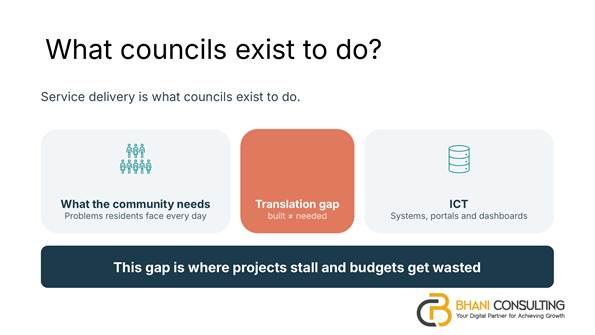
Service delivery is what councils exist to do. The translation gap sits between what’s built and what’s needed.
The numbers back it up
A gut feeling isn’t enough, so before the session I looked for data. Here’s some of what I found:
- Only 55.4% of citizens use local council digital services, well below federal (88.3%) and state (80%) services.
- Just 3% of Australian councils have reached the digital transformation stage, and 82% are not yet “best in class” on digital.
- 65% of residents say council services haven’t changed in four years.
I want to be careful with the first number. It doesn’t necessarily mean federal and state technology is better. Councils may simply offer better phone and email support, so people don’t need to go online. But taken together, the figures show that spending is happening and outcomes aren’t following.
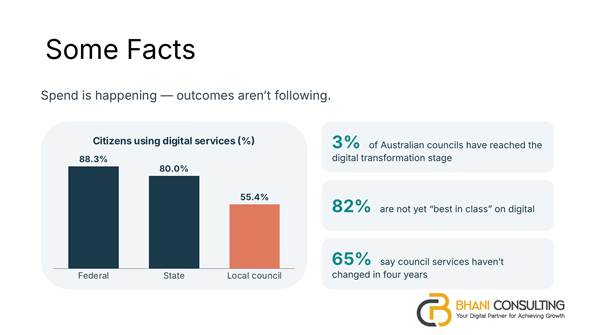
Spend is happening, but outcomes aren’t following.
Residents told researchers where they get stuck: they can’t find information, the language is too complex, there’s no timely human support, processes take too long, and they can’t see progress. So they ring and email, which creates more work for everyone. And 56% of financially precarious residents, around 1.4 million people, use no council digital services at all.
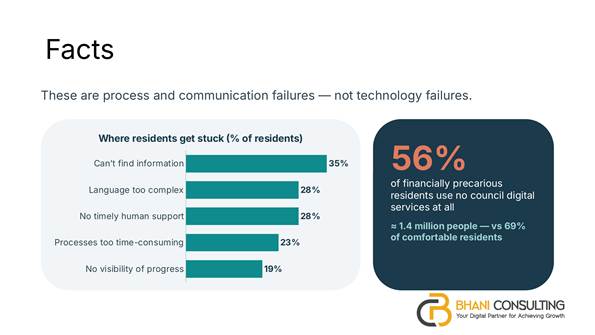
Where residents get stuck. These are process and communication failures, not technology failures.
When councils were asked why digital initiatives fail, the answers weren’t about technology. They pointed to culture and readiness (31%), citizen experience (28%) and data (16%). The councils that ranked highest nationally for resolution speed and communication had one thing in common: a quick, continuous feedback loop with their community.
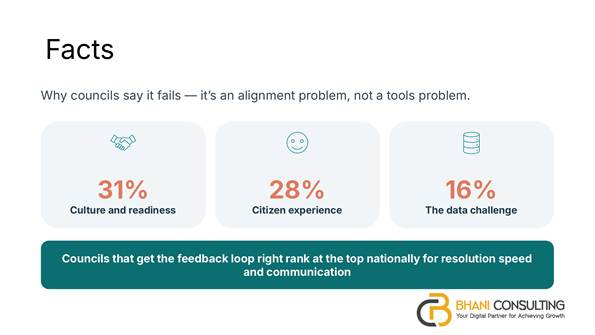
Why councils say it fails: an alignment problem, not a tools problem.
One attendee asked whether low uptake might reflect an older population. It’s a fair question, but the surveys covered residents across the community and across several states, so I don’t think age explains it. Another attendee, who had worked in councils, pointed to something I think matters more: a reluctance to change something that already works.
Our standard process is back to front
Here’s how most technology projects run, in councils and elsewhere. We have a problem, so we buy a system. Then we migrate and reshape our data to fit it. Then we bend our processes around what the system can and can’t do. Finally we go live and hope it lands with the community.
The system gets delivered. The service outcome often doesn’t.
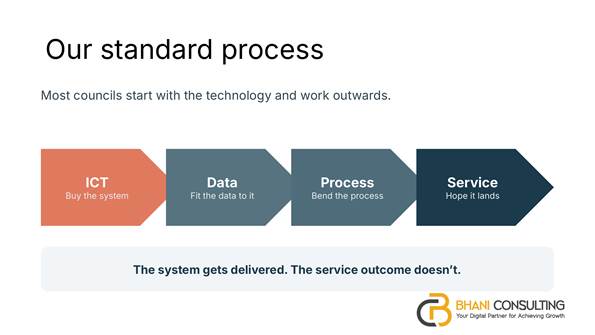
Most councils start with the technology and work outwards.
Flip it: start with the service
A better approach is to work the other way:
- Service: what are we delivering for the community? How do people want to access it, how do they want to see progress, and how much human contact do they need?
- Process: how does the work actually flow?
- Data: what does that process need to know?
- ICT: what system best supports all of the above?
In this model, ICT is the engine, not the destination. We start with the end in mind and work backwards.
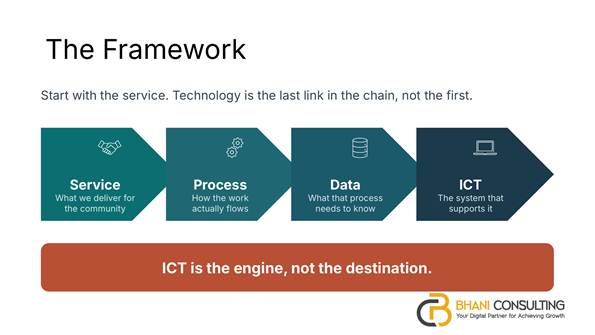
Start with the service. Technology is the last link in the chain, not the first.
I was asked whether I’d delivered this model in full to a council. Honestly, no. In its pure form it’s a big shift, and council budgets and timelines rarely allow for what can look like a research project. But that’s not a reason to ignore it. It’s a reason to find practical steps towards it.
The group had useful thoughts here. One attendee felt the biggest gap is in the middle, in process and data. Organisations know what services they deliver, but they’re less sure what good process and data look like, especially now that AI agents can automate routine tasks. That often means redesigning processes, not just digitising them. I’d go further and see AI as a layer under all four steps. It can now help us understand services in ways that weren’t possible two years ago, by learning from complaints, requests and usage data. Another attendee, who works with government, agreed AI can remove bottlenecks without disrupting how a council already operates.
There was also a frank observation from the vendor side: many technology products are poorly aligned with how local government services actually work. Council services, forms, records and compliance needs are well known, yet few products handle them well. In WA, where small populations mean small budgets, that underperformance is something the whole sector owns, whether you’re a council, a software supplier or a consultant.
A practical middle path: the feedback loop
So what can councils do today? Keep the standard delivery approach everyone understands, but keep a clear eye on the service. Then, after go-live, run a continuous loop:
- Deliver: ship the service change.
- Measure: track the outcome, not the ticket.
- Listen: ask what actually changed for people.
- Improve: fix the root cause, then feed what you learn into the next cycle.
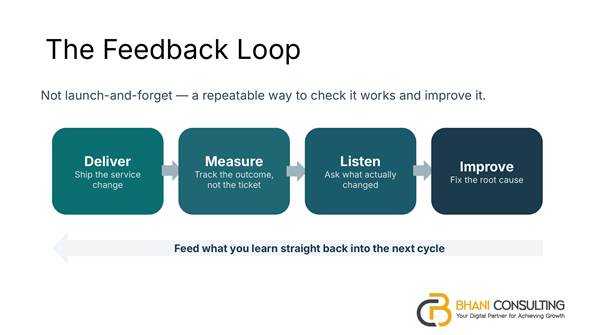
Not launch-and-forget: a repeatable way to check it works and improve it.
This is the step most organisations skip. The project team delivers, phase one is declared done, the team is disbanded and everything goes to support. Nobody goes back to measure the impact.
I’d like to see this become normal practice: if a project takes a year, plan for another two years to mature the product, with a smaller team kept in place and a budget to match. Directors need to secure that time and money up front, otherwise we just flick from one project to the next.
One attendee described it as leaning towards agile without going fully agile, which most councils wouldn’t support anyway. People rarely know exactly what they need until they see a solution, so nothing lands perfectly first time. Another warned of a common trap: without a stable improvement budget, every fix becomes a change request that waits for the next budget cycle, and you never quite get what you wanted. A third suggested regular health checks, quarterly or annually, to keep systems tuned and make use of new technology. And one attendee stressed proper discovery before any investment: assess where you are, then talk to every level of staff, not just the CEO, because the people using the systems know where the real problems are. That leads to a prioritised roadmap with budgets attached, so councillors can decide what comes first.
The core message
We don’t need more tools, more dashboards or another portal. We need better alignment between services, processes and technology.
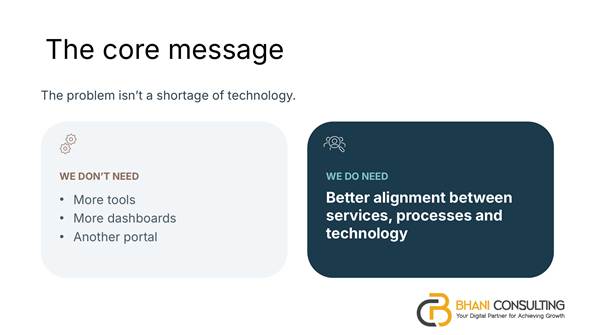
The problem isn’t a shortage of technology.
That alignment starts with community. Bring them in before budgets are set, while the money is still flexible. Before projects start, while scope can still change. And before committees decide, while decisions are still open. It saves months of misalignment and wasted spend.
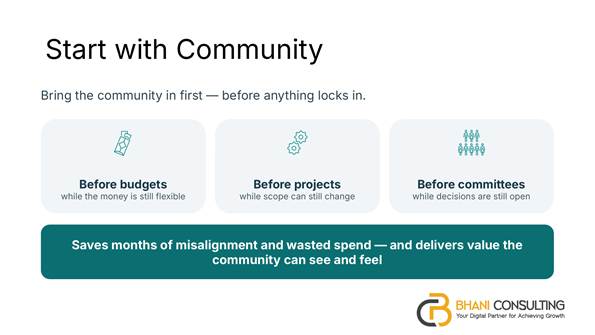
Bring the community in first, before anything locks in.
Before you build anything, ask three questions:
- Do we have community representatives as key stakeholders?
- Do we fully understand the service before we configure the ERP?
- Do we fully understand the community’s experience of our services?
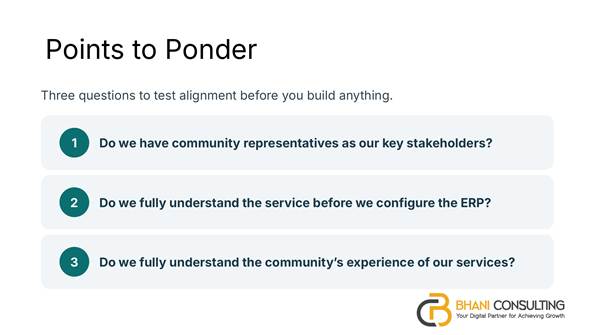
Three questions to test alignment before you build anything.
Measure what the community feels
Finally, look at how success is measured. Most service teams track closure rates, speed of delivery and the number of channels offered. They’re easy to count, but they mostly measure how busy we are.
- Experience, not closure rate. What was it like for the person who asked for help?
- Root cause, not speed. If we closed 100 waste management tickets, why did they come in? Technology and AI can help answer that.
- Engagement, not number of options. Are people actually using and trusting the services we offer?
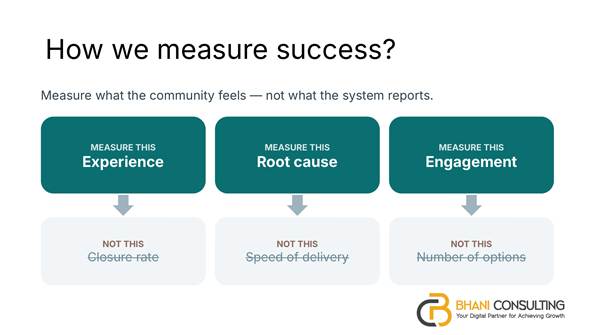
Measure what the community feels, not what the system reports.
The takeaway
If I had to sum up the session in three lines:
- Start with the end in mind. Understand the service before you choose the system.
- Engage the people who matter early. Make the community a key stakeholder from day one.
- Measure the right things. Experience, root cause and engagement tell you whether it’s working.
Go-live isn’t the finish line. It’s the point where the real learning starts.